
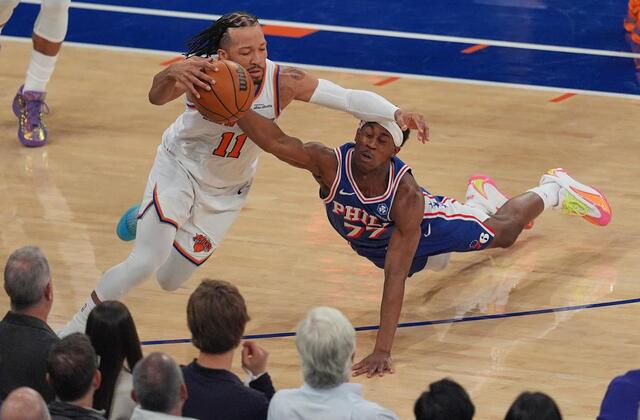
The New York Knicks did not just win their Eastern Conference Semifinals opener, they made a loud statement that echoed across the league. At Madison Square Garden on May 4–5, 2026, the Knicks overwhelmed the Philadelphia 76ers with a 137–98 victory in Game 1, setting the tone early in the series and putting immediate pressure on one of the East’s strongest contenders.
From the opening minutes, New York played with intensity, rhythm, and confidence that Philadelphia simply could not match. By halftime, the game was already slipping away, and by the third quarter, it had turned into a full control situation for the Knicks.
First-Half Explosion Sets the Tone
The biggest story of the night was Jalen Brunson, who delivered a superstar performance when it mattered most. He finished with 35 points, including a blistering 27 points in the first half alone. His shot selection was sharp, his pace controlled, and his ability to break down the defense kept the Knicks ahead comfortably.
New York’s offensive execution in the first two quarters was nearly flawless. Ball movement was quick, spacing was clean, and open looks were consistently created both inside the paint and beyond the arc. The Knicks shot at an extremely high efficiency rate, reportedly around the mid-60% range from the field, which immediately put Philadelphia on the back foot.
Knicks’ Historic Momentum and Efficiency
This win did not happen in isolation. It extended a remarkable postseason run for New York, which has now recorded three consecutive playoff wins by 25 points or more. That kind of dominance is rare in NBA playoff history and highlights how complete this Knicks team has been on both ends of the floor.
Defensively, New York was just as impressive as they were on offense. They pressured ball handlers, disrupted passing lanes, and forced turnovers that quickly turned into fast-break points. Philadelphia struggled to settle into any offensive rhythm, often rushing possessions or settling for contested shots.
The Knicks also controlled the paint on both ends. Their rebounding advantage gave them multiple second-chance opportunities while limiting the 76ers’ ability to reset possessions.
76ers Struggle Under Pressure
For Philadelphia, Game 1 was a difficult reality check. The star trio of Joel Embiid, Tyrese Maxey, and Paul George never fully found rhythm as the Knicks’ defense continuously disrupted their sets.
By early in the third quarter, the deficit had stretched beyond 40 points, forcing the 76ers to pull their starters earlier than expected. That decision reflected how one-sided the game had become and how little momentum Philadelphia could generate against New York’s pace and physicality.
Turnovers were a major issue for the 76ers. Many of them came in transition or under defensive pressure, leading to easy points for the Knicks. When they did manage to create open looks, inconsistency in shooting further widened the gap.
Tactical Breakdown: Why the Knicks Controlled the Game
New York’s dominance came down to a few key tactical advantages:
- Fast transition offense: The Knicks consistently converted defensive stops into quick scoring opportunities before the 76ers could set their defense.
- Paint control: Interior dominance allowed New York to score efficiently and draw fouls in high-value areas.
- Perimeter spacing: Shooters stayed active, pulling defenders out and opening driving lanes.
- Defensive pressure: Aggressive ball pressure forced rushed decisions and disrupted Philadelphia’s playmaking structure.
This combination created a game environment where the 76ers were constantly reacting instead of executing their own plan.
Series Impact and What Comes Next
With this win, the Knicks take a 1–0 lead in the series and immediately shift pressure onto Philadelphia ahead of Game 2. Momentum in playoff series often swings quickly, but a 39-point blowout sends a strong psychological message.
Game 2 is scheduled for May 6, 2026, and will be another critical test for both teams. The 76ers will need to adjust their defensive matchups, reduce turnovers, and find more efficient scoring options if they want to avoid falling into a deep series deficit.
For the Knicks, the focus will be consistency. Maintaining defensive intensity and avoiding complacency will be key, especially as Philadelphia is expected to respond with urgency.
Bigger Picture: Knicks Emerging as a Contender
Beyond just Game 1, this performance reinforces the Knicks’ growing reputation as a serious championship contender in 2026. Their ability to dominate playoff games by large margins shows a level of balance that many teams struggle to achieve at this stage of the season.
Jalen Brunson’s leadership continues to be a defining factor, but the supporting cast has also stepped up significantly. When a team can win through both offensive efficiency and defensive disruption, it becomes difficult for opponents to find answers over a seven-game series.
Final Outlook
The Knicks’ 137–98 victory over the 76ers was not just a win, it was a statement of intent. It highlighted execution, discipline, and playoff readiness at the highest level.
Philadelphia now faces the challenge of regrouping quickly before Game 2, while New York will aim to build on one of its most dominant postseason performances in recent memory.
As the series continues, all eyes remain on whether the 76ers can respond or if the Knicks will continue their commanding run through the Eastern Conference playoffs.