
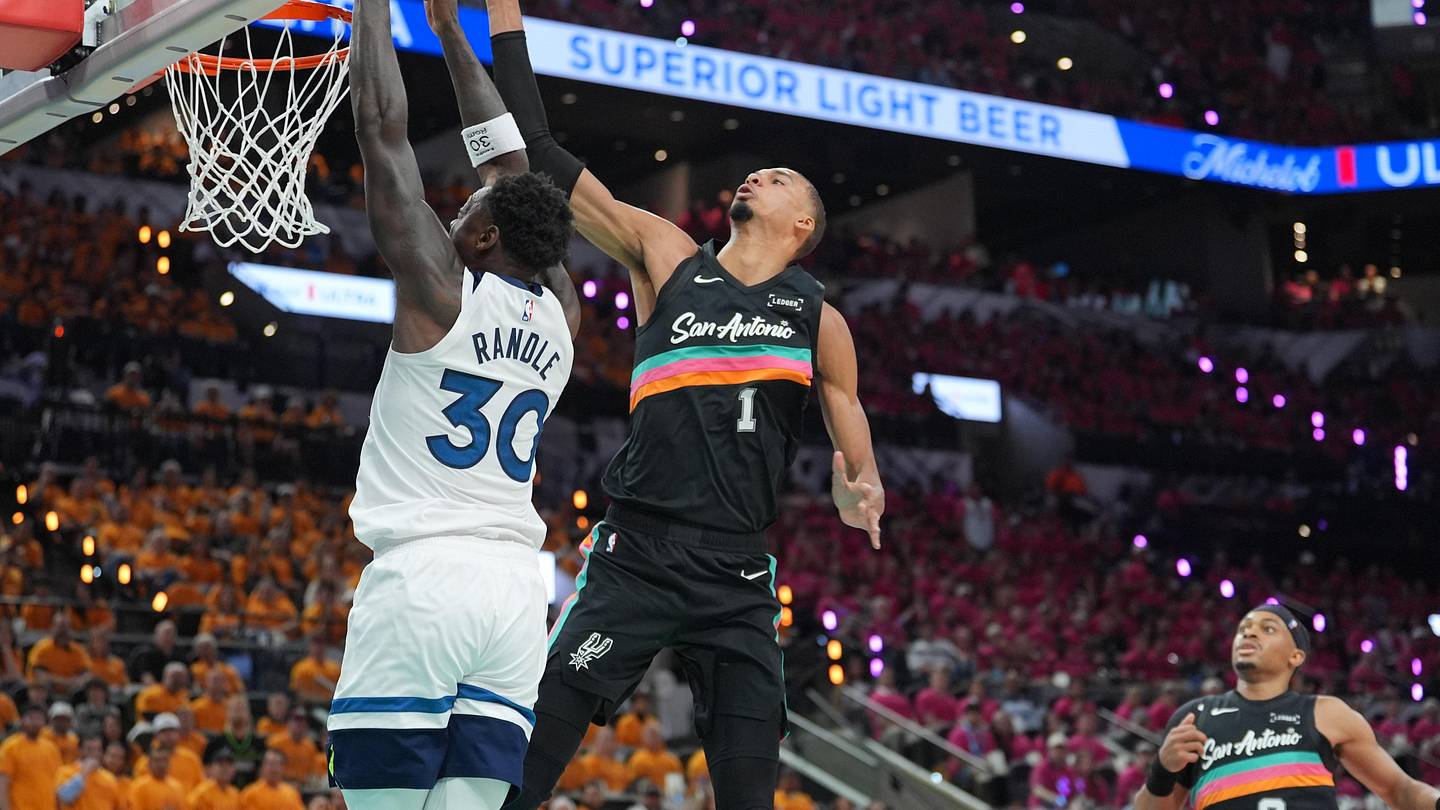
Playoff basketball has a way of turning expectations upside down, and Game 1 of the Western Conference Semifinals in 2026 was exactly that kind of night. In San Antonio, what looked like a controlled home opener for the Spurs turned into a late collapse, as the Minnesota Timberwolves pulled off a dramatic 104–102 win at the Frost Bank Center.
It was not a game that followed a simple script. Minnesota stayed alive through stretches where they looked outplayed, then flipped the momentum when it mattered most. Even with Victor Wembanyama producing a defensive performance that will be talked about for years, the Spurs still could not close it out in the final seconds.
Timberwolves Show Resilience to Steal Game 1 on the Road
The Timberwolves came into this series as underdogs on paper, but their approach on the night showed confidence built from their earlier playoff run. After pushing past the Denver Nuggets in the first round, Minnesota arrived with a clear identity: defend, survive pressure moments, and rely on key scoring bursts.
Julius Randle led the charge offensively with 21 points and 10 rebounds, setting the tone inside the paint when the game tightened. Anthony Edwards, returning from injury, did not dominate the scoreboard with volume, but his 18 points came at critical moments, especially when Minnesota needed to stop Spurs runs.
Terrence Shannon Jr. also gave the Wolves valuable support, contributing energy plays that helped keep possessions alive late in the fourth quarter.
What defined Minnesota’s win was not just scoring, but timing. They handled the Spurs’ defensive pressure better in the closing minutes and forced San Antonio into rushed decisions, including the final missed three-pointer from Julian Champagnie at the buzzer.
Victor Wembanyama’s Historic Performance in a Losing Effort
If the Spurs lost Game 1, Victor Wembanyama still walked away with one of the most dominant defensive playoff performances ever recorded.
The 22-year-old French star finished with 11 points, 15 rebounds, and an astonishing 12 blocks, setting a new NBA playoff single-game record for rejections. It was a rare statistical line that placed him in elite historical company, as very few players in league history have ever recorded a triple-double involving blocks in postseason play.
Wembanyama’s timing was overwhelming from the start. He blocked seven shots in the first half alone, disrupting Minnesota’s rhythm every time they tried to attack the rim. His presence alone changed shot selection, forcing the Timberwolves into hesitation even when he was not directly contesting.
By the fourth quarter, he had already broken the previous playoff blocks record of 10, then extended it further to 12 before the final buzzer.
Despite this, the Spurs struggled to convert his defensive dominance into a winning formula. Their half-court offense stalled at key moments, and Minnesota’s defensive spacing prevented San Antonio from fully capitalizing on second-chance opportunities.
There was also quiet debate among fans online about a couple of contested goaltending and foul decisions, but the official scoring stood, and Wembanyama’s record remains intact.
Why the Spurs Lost Despite Defensive Control
San Antonio entered the playoffs with one of the strongest regular-season records in the league, finishing 62–20 and securing the second seed. On paper, they had control. On the court, Game 1 exposed a familiar playoff truth: defense alone does not finish games.
Even with Wembanyama anchoring the paint, the Spurs lacked consistent perimeter scoring. Late-game possessions became predictable, and Minnesota adjusted well by crowding driving lanes and forcing outside shots under pressure.
De’Aaron Fox and Dylan Harper were expected to balance the offense, but the Wolves’ defensive rotations limited their impact in crunch time. As a result, San Antonio ended up relying heavily on isolation plays rather than structured ball movement.
That imbalance became the difference in a two-point game.
Series Outlook: A Western Conference Battle Taking Shape
This series now shifts into a much more unpredictable direction. Minnesota’s Game 1 win immediately flips pressure back onto San Antonio, especially with Game 2 approaching within days.
The Timberwolves have already shown they can survive Wembanyama’s interior dominance, which is not something many teams can claim. Their confidence will grow from this result, especially knowing they can win even when the Spurs’ defense reaches historic levels.
For San Antonio, adjustments are urgent. They need more offensive rhythm and less reliance on individual moments. If Wembanyama continues producing defensive history but the team fails to convert it into wins, the Spurs risk letting a strong season slip into early playoff frustration.
Victor Wembanyama: Rise of a Global Basketball Phenomenon
Beyond this single game, Wembanyama’s story continues to expand his global influence. Born in Le Chesnay, France, and developed through Nanterre 92, ASVEL, and Metropolitans 92, his rise was expected but still feels unprecedented in execution.
Selected first overall in the 2023 NBA Draft by the Spurs, he quickly evolved into a franchise-defining player. By 2026, he had already collected Defensive Player of the Year honors, All-Star appearances, and Olympic recognition with France.
At 7-foot-4, his combination of mobility, timing, and coordination has made him one of the most unique defensive players the league has ever seen.
Off the court, his career is equally structured. His rookie contract is estimated around $55 million over four years, with future extensions projected to reach superstar levels. Endorsements with global brands like Nike and Louis Vuitton have strengthened his financial profile, while his growing net worth continues to rise rapidly as his global profile expands.
Unlike many rising stars, Wembanyama maintains a relatively quiet lifestyle, focusing heavily on development rather than public excess. That discipline is part of why his image remains strong across both American and European basketball audiences.